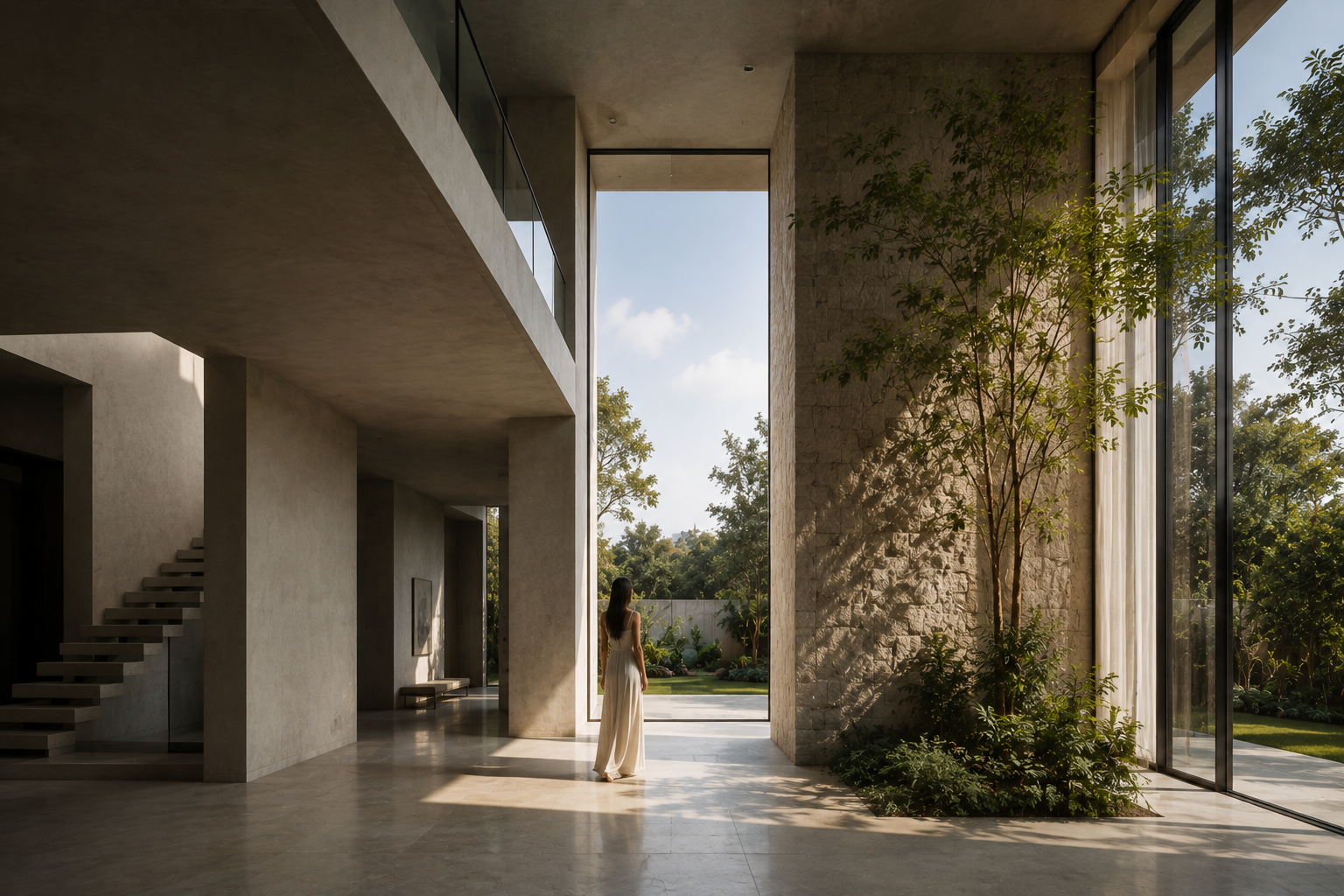
How to Choose the Best Architect in Pune for Your Luxury Villa
A luxury villa is not something you choose from a catalogue.
It begins with an idea — perhaps a site you have already purchased, a view you want to preserve, a certain way of living you have imagined, or simply the feeling you want when you come home.
And then comes one of the most important decisions in the entire project:
Who should design it?
Pune has no shortage of architects. There are established practices, young studios, multidisciplinary firms and designers with impressive portfolios.
So how do you choose?
For a luxury villa, the answer is rarely found by comparing names, fees or the most impressive photograph on a website.
The right architect should understand your site, your aspirations, your family, your way of living and the level of detail your home deserves.
Because once construction begins, many of the decisions that shape your experience of the house have already been made.
The proportions of the rooms. The way you arrive. The privacy of the bedrooms. The relationship with the garden. The morning light. The materials under your feet. The view from the living room. Even the way guests and service move through the house.
Choosing your architect is therefore not simply choosing who will draw your villa. It is choosing who will shape the experience of living in it.
Look Beyond the Portfolio: Look for the Thinking Behind It
A portfolio is the obvious place to begin, but it should not be the place where your evaluation ends.
You may see a beautiful façade and immediately think, “This is exactly what I want.”
Look again.
Ask yourself:
Why does this villa work?
Is it the proportion of the volumes? The way the building sits on the site? The relationship between the house and landscape? The quality of natural light? The privacy? The material palette? The way the spaces flow from one to another?
A strong architect should be able to explain these decisions.
This is an important distinction between a portfolio of attractive buildings and a body of architectural thinking.
You should look for completed projects that demonstrate how the architect responds to different sites, different families and different requirements.
A good sign is consistency in the thinking without repetition in the appearance.
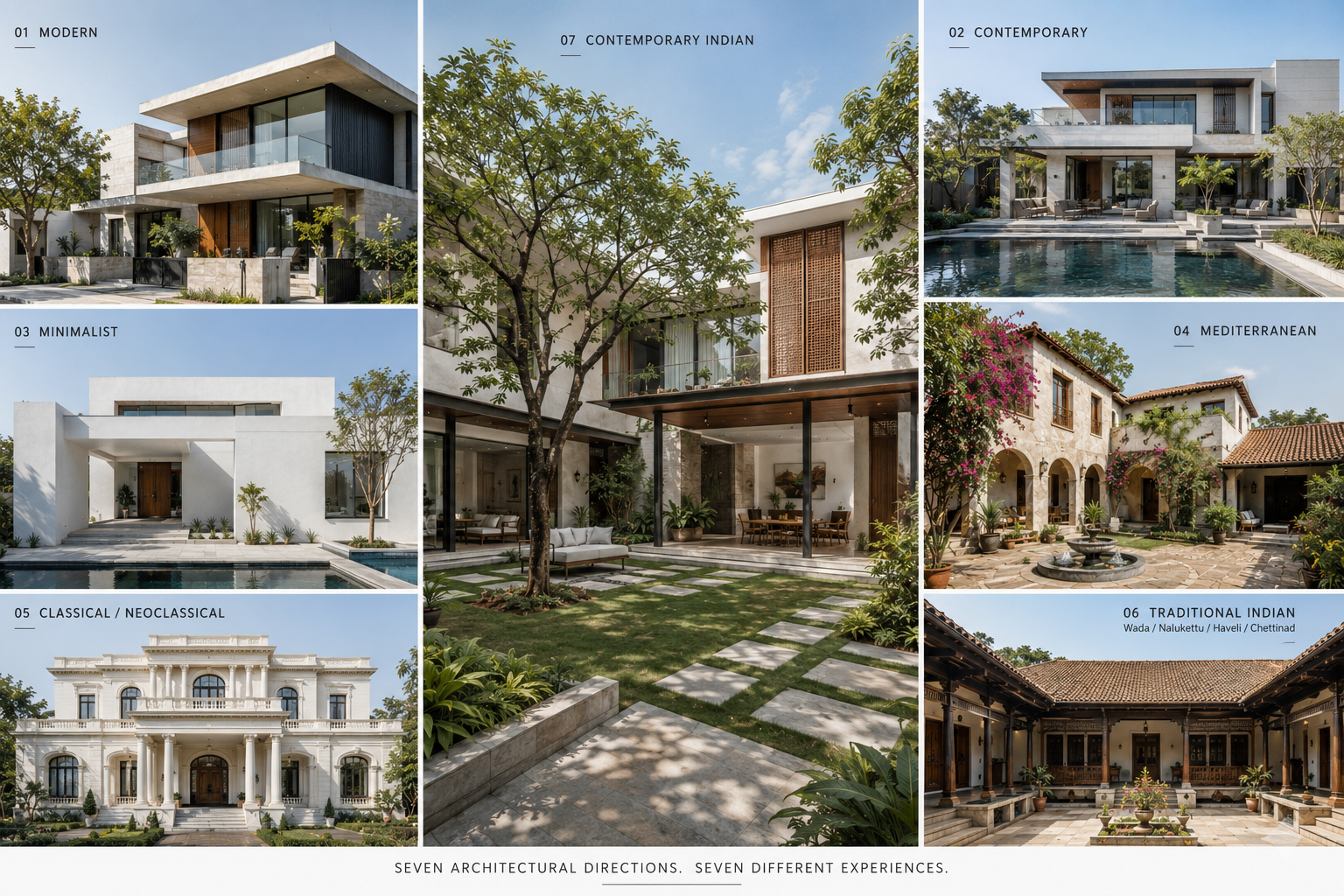
The villas do not all need to look alike.
In fact, they shouldn't.
A hillside property, an urban plot and a large landscaped estate should produce different architecture. What should remain consistent is the quality of the decisions behind them.
The best architect for your villa may not be the architect with the most recognisable façade. It may be the one whose way of thinking you trust.
Choose an Architect Who Designs for Your Life, Not for Instagram
Most homeowners begin with references.
There may be dozens of saved images on Instagram, Pinterest, Houzz or architectural websites.
One villa has the perfect staircase. Another has a beautiful courtyard. Another has an extraordinary pool. Another has a façade you immediately fall in love with.
These references are useful.
But they are not yet a design brief.
Your villa is not a collection of photographs.
It is where your family will wake up, entertain, work, relax, celebrate, host guests and grow older.
Perhaps your parents will live with you.
Perhaps you entertain often.
Perhaps privacy matters more than a dramatic frontage.
Perhaps you want a home that opens completely to the landscape. Or perhaps you want the opposite — a private sanctuary that reveals itself gradually as you move through it.
Your architect needs to understand these things before deciding what the building should look like.
This is why the first conversation with a good architect should contain questions about how you live, not just questions about the number of bedrooms and the preferred style.
The most successful villas are often the ones where the architecture feels almost inevitable because it has been shaped around the people who live there.
Your architect should not design the house you saved. They should discover the house you actually need.
The Right Architect Will Look at Your Site Before Designing Your Villa
Every site has something to say.
Sometimes it is obvious — a spectacular view, a mature tree, a natural slope.
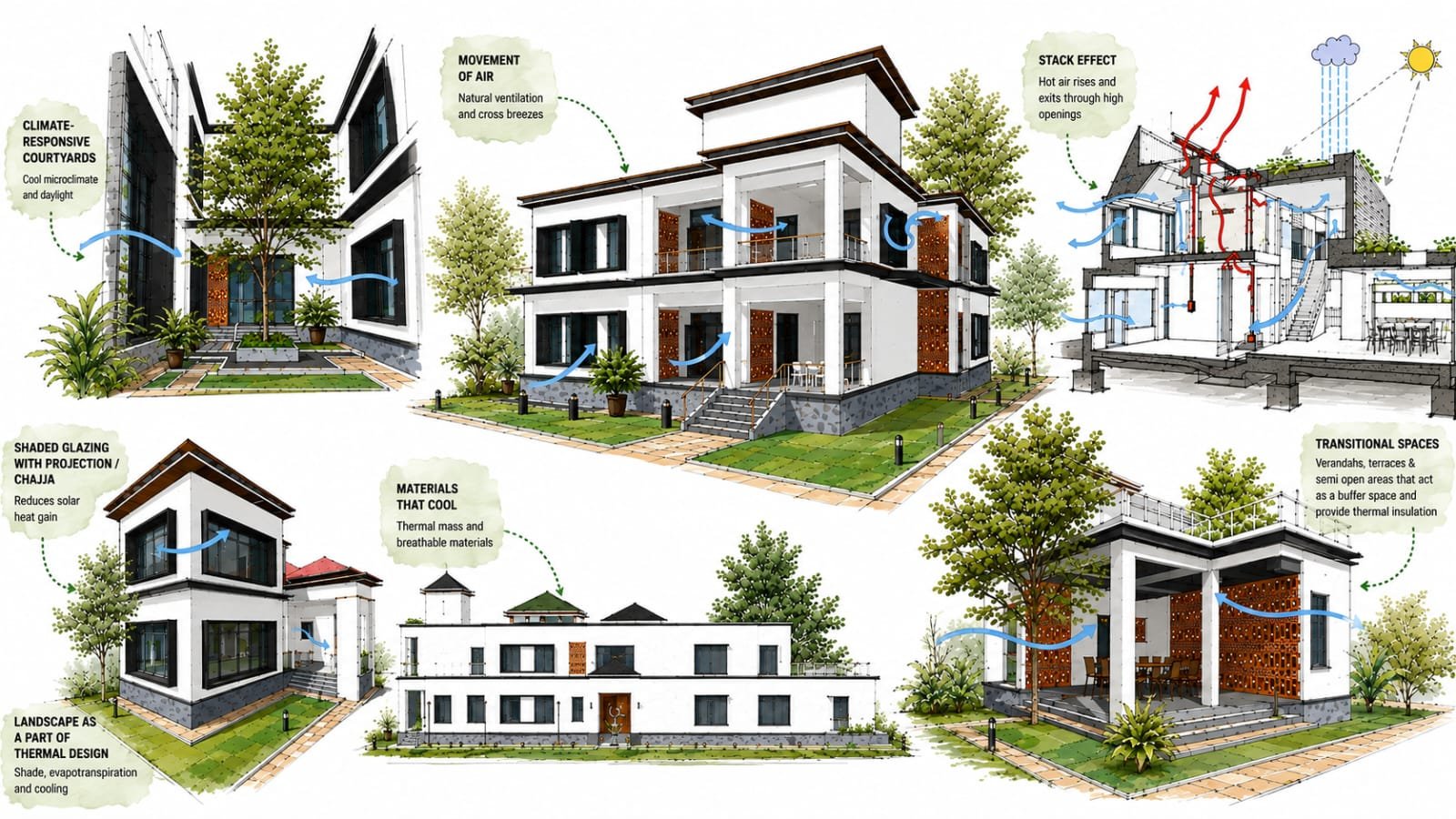
Sometimes it is subtle — the direction of the afternoon sun, the movement of wind, the relationship with a neighbouring property or the way the approach road reaches the site.
Before deciding where the façade should go, a thoughtful architect should understand:
- Orientation
- Views
- Existing vegetation
- Site levels and slope
- Access
- Neighbouring properties
- Privacy
- Sun and shade
- Wind
- Rain and monsoon conditions
- Landscape opportunities
The objective is not simply to fit a building onto a plot.
It is to understand what the plot can become.
A mature tree may become part of the arrival experience. A distant hill may determine the orientation of the living room. A difficult western exposure may influence the placement of bedrooms and service spaces. A slope may allow the house to be layered rather than simply stacked.
This kind of site-responsive thinking is central to the architectural approach of Ar. Nitin Markad and Rajmudra Architects.
The architectural language should emerge from the relationship between site, lifestyle and experience, rather than being imposed on the property from the beginning.
A villa should feel as though it belongs to its site.
Before deciding what your villa should look like, understand what your land is already telling you.
Don't Choose the Most Impressive Villa. Choose the Architect Who Can Create Yours.
This is where choosing an architect becomes more personal.
You may visit a completed villa and immediately fall in love with it.
Perhaps it has an extraordinary entrance. Perhaps the materials are exceptional. Perhaps the scale is impressive.
But your site is different.
Your family is different.
Your climate, views, budget, routines and aspirations are different.
The real question is therefore not:
“Can this architect reproduce that villa?”
It is:
“Can this architect understand what I responded to in that villa and translate that quality into something that belongs to me?”
That is a much higher level of design thinking.
Perhaps what attracted you was not the façade at all.
Maybe it was the privacy.
Maybe it was the connection with the garden.
Maybe it was the calmness of the interior.
Maybe it was the way the house opened towards the view.
A good architect can identify the underlying desire and reinterpret it.
That is why the strongest luxury villas are rarely copies of references.
They have their own identity.
You should not want a house that simply looks like another architect's project. You should want a villa designed around your own site, lifestyle and aspirations.
For a Luxury Villa, the Principal Architect Matters
A private villa is a deeply personal project.
You are not simply appointing a company. You are entering a long design conversation with the people responsible for interpreting your aspirations.
So one question is worth asking every architectural practice:
Who will actually design my villa?
Will the principal architect be involved?
Who will interpret your brief?
Who will make the major design decisions?
Who will review the drawings?
Who will discuss important changes with you?
Who will be responsible for the architectural direction as the project develops?
These questions become increasingly important as the scale and complexity of a residence increase.
At Rajmudra Architects, Ar. Nitin Markad is the Principal Architect, and his role is central to the architectural direction of the practice.
For a highly personal residence, understanding who is responsible for the architectural direction — and how involved that person will remain — is an important part of choosing the right architect.
For a project that may take years to design and build — and decades to live in — that relationship matters.
You should know who is shaping the decisions that will ultimately shape your home.
Look for an Architect Who Sees the Whole Property, Not Just the Building
A luxury villa does not end at the external wall.
The experience begins before you enter the house.
It may begin at the gate.
Then the driveway.
The landscape.
A tree.
A courtyard.
A water body.
A shaded transition.
The entrance.
The living spaces.
The pool.
The garden.
The view.
And finally, the interiors.
When these elements are designed independently, the property can feel fragmented.
When they are conceived together, the villa can feel completely different.
This is why architecture and landscape should not be treated as separate layers added at different stages.
Landscape can frame an opening.
A courtyard can bring light deep into the plan.
A pool can become an extension of the living spaces.
A tree can determine the position of a window.
An outdoor room can become part of the family's everyday life.
Rajmudra Architects brings architecture and landscape thinking together as part of its residential design approach.
The best villas do not look like a building placed in a garden. They feel as though the building and landscape belong to one idea.
Ask How the Architect Makes Luxury Feel Effortless
Luxury is often misunderstood as more.
More marble.
More glass.
More height.
More decoration.
More technology.
But the most sophisticated luxury is often about what you don't notice.
You don't notice the service movement because it has been planned properly.
You don't notice where deliveries happen.
You don't think about storage because there is enough of it.
You don't see the mechanical systems.
You don't have to cross a formal guest space to reach a private bedroom.
You don't struggle with afternoon glare because the openings and shading were considered from the beginning.
Your guests experience a calm, effortless home.
Behind that experience are hundreds of decisions.
Service circulation.
Staff access.
Parking.
Storage.
Security.
Housekeeping.
Utilities.
Lighting.
Acoustics.
Climate control.
Maintenance.
These aren't glamorous subjects, but they are part of luxury architecture.
The best luxury is often the part of the house your guests never notice.
Understand the Architect's Process Before You Appoint Them
A luxury villa is not designed in one meeting.
It evolves.
A professional architectural process should give you clarity about how an initial idea becomes a built home.
The exact process differs between practices, but broadly it should involve:
Understanding → Site Study → Concept → Spatial Planning → Design Development → Documentation → Consultant Coordination → Construction Support
At the beginning, the architect should understand your brief and the site.
The concept establishes the larger architectural direction.
Planning resolves how the house actually works.
Design development refines proportions, materials, openings, landscape and details.
Documentation translates those decisions into information that can be built.
Consultant coordination brings together structure, services and other specialist requirements.
Construction-stage involvement helps the design remain coherent as the building becomes real.
The value of a clear process is not bureaucracy.
It is confidence.
You know what happens next.
You understand when decisions need to be made.
You can see how one decision affects another.
A well-defined process makes a complex project feel manageable.
Don't Ask Only “What Is Your Fee?” Ask “What Am I Getting?”
Professional architectural fees can vary significantly.
But comparing architects only by the number at the bottom of a quotation can be misleading.
Two architects may quote different fees while offering very different levels of service and involvement.
Instead of asking only:
“What is your fee?”
ask:
“What does your fee include?”
Does it include design development?
How detailed are the drawings?
How are consultants coordinated?
Are structural and MEP requirements integrated?
How are approvals handled?
How many design iterations are included?
How frequently is the architect involved during construction?
Who reviews important site decisions?
The value of architecture lies not simply in producing drawings.
It lies in the thinking, coordination, experience and decisions that happen before and during construction.
For a luxury villa, a difference in professional fees can be relatively small compared with the long-term consequences of getting a major architectural decision wrong.
The better comparison is therefore not:
Architect A costs less than Architect B.
It is:
What level of thinking, involvement and responsibility am I receiving from each?
Why Pune Needs a Different Kind of Villa Architect
Pune is not one architectural condition.
A luxury villa in an established urban neighbourhood can present completely different challenges from a large property on the outskirts of the city.
A site in Bavdhan, Baner or Kothrud may require careful consideration of neighbouring buildings, privacy, access and urban constraints.
A property around Pirangut or Mulshi may offer very different opportunities — larger plots, landscape, slopes, views and a stronger relationship with the surrounding terrain.
Even within the same region, no two sites are truly identical.
This is why choosing someone simply because they are an architect “in Pune” is not enough.
The more useful question is:
Does this architect understand the kind of site and villa I am planning?
A luxury villa requires an architect who can move comfortably between the larger vision and the smallest decision.
Between the site and the interior.
Between architecture and landscape.
Between design and construction.
The best architect in Pune for your villa is not necessarily the best architect for every villa. The right choice is the architect whose experience and thinking align with your project.
10 Questions That Will Help You Choose the Right Villa Architect
Before appointing your architect, a good conversation should answer questions such as these:
1. Have you designed villas similar to mine?
Look for experience that is relevant to your project's scale, site and aspirations.
2. Can I see completed projects?
Real, completed buildings can tell you much more than polished renders.
3. How do you approach a new site?
Listen for questions about orientation, views, landscape, privacy, climate and context.
4. Who will personally lead my project?
Know who will actually be responsible for the architectural direction.
5. How involved will the principal architect be?
For a highly personal residence, direct architectural leadership can make a meaningful difference.
6. How do you integrate landscape and architecture?
The answer should go beyond simply recommending a landscape contractor later.
7. What exactly is included in your professional fee?
Understand the scope before comparing quotations.
8. How do you coordinate structural and specialist consultants?
A complex villa requires more than architectural drawings.
9. How do you approach budget and material decisions?
A good architect should understand where investment creates lasting value.
10. Can I speak with a previous client?
A conversation with someone who has actually gone through the process can be extremely valuable.
The purpose of these questions is not to interrogate an architect.
It is to understand how they think.
And once you understand that, choosing becomes much easier.
The Best Architect for Your Villa Is the One You Can Trust With the Details
By this point, the question has changed.
You are no longer simply asking:
“Who is the best architect in Pune?”
You are asking:
“Who is the right architect for my villa?”
That distinction matters.
The right architect should understand your site.
Your family.
Your aspirations.
Your budget.
Your lifestyle.
Your future.
But there is something more.
A good architect should also be able to see what you cannot yet see.
The relationship between a room and a garden.
The opportunity hidden in a difficult site.
The reason one material will age better than another.
The way a morning view can change the planning of an entire house.
The service problem that could become a daily frustration five years later.
The detail that seems insignificant during design but becomes something you experience every day.
The right architect doesn't simply answer the questions you bring to the first meeting. They help you discover the questions you didn't know you needed to ask.
That is where architectural experience becomes valuable.
Why Rajmudra Architects
Architecture by Ar. Nitin Markad
At Rajmudra Architects, we don't believe a luxury villa should begin with a style.
It should begin with an understanding of the site, the family and the life the house needs to support.
Led by Ar. Nitin Markad, Principal Architect, the practice approaches luxury residential architecture as an integrated design exercise — bringing together architecture, landscape, spatial planning, materials and the experience of living in the completed home.
The objective is not to impose a predetermined Rajmudra look on every project.
A villa should respond to its own place.
Its own landscape.
Its own climate.
Its own family.
Its own aspirations.
That is why two residences designed by the same practice can look completely different while sharing the same underlying commitment to thoughtful planning, proportion, materiality and long-term living.
The goal is not to make your villa look like a Rajmudra villa.
The goal is to make it feel as though it could only have been designed for you.
Choosing an Architect Is the First Design Decision
A luxury villa may take years to design and build.
You may live in it for decades.
Long after the drawings have been archived and construction has been completed, you will continue to experience the decisions your architect made — in the way sunlight enters the house, the way you move through it, the way the garden meets the living spaces, the privacy of your rooms and the ease with which everyday life unfolds.
That is why choosing your architect deserves more thought than simply comparing portfolios or professional fees.
You are choosing the person you will trust with hundreds of decisions that have not yet been made.
So perhaps the better question is not:
“Who is the best architect in Pune?”
It is:
“Who is the architect I trust to understand the home I have yet to build?”
That is where the right architectural relationship begins.
Ar. Nitin Markad
Principal Architect, Rajmudra Architects
Begin a Project